Thursday, 14 January 2016

Flight into Egypt - Refugee journeys


Look at the picture.
  • Who is the picture of?
  • How do you think Mary and Joseph feel? How do you know?
  • What is Joseph carrying? What about all the other things they own – furniture? clothes?

We know all the stories about when Jesus was born – (ask what they can remember)

But after that, I wonder what happened next.

Do you remember King Herod? He was the king the wise men went to see. He was angry at the thought there might be a new king. He was king and he wanted it to stay that way.
He wanted to get rid of this new baby.

Joseph was asleep one night when he had a dream. In his dream an angel told him that Herod wanted to kill his child.
As soon as he woke up he told Mary that they must leave Bethlehem as fast as they could to escape to somewhere safe.
They gathered all their things together and set out for Egypt.
It was only just in time, because Herod’s soldiers were heading towards Bethlehem. They managed to escape though.

·         What might it have been like to arrive in Egypt? (The children talked about the feeling strange and not having friends, but also feeling safe )

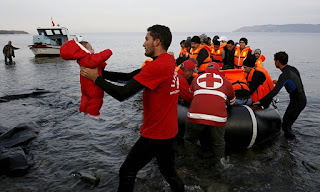
Look at some pictures of modern refugees, people making dangerous journeys. They are escaping from Syria where there is fighting. They come across the sea in little boats looking for safety. 
http://www.theguardian.com/society/2015/nov/24/guardian-and-observer-refugee-appeal-2015-the-charities#img-1
http://www.theguardian.com/society/2015/nov/24/guardian-and-observer-refugee-appeal-2015-the-charities


  • What is happening?
  • What might feel scary about making this journey?
  • What might feel good about it? 
  • What might help them? 
 Prayer for Refugees, people who have to take journeys they don’t want to take. For those who welcome and help them.

http://www.redcross.org.uk/What-we-do/Teaching-resources/Quick-activities/

Thursday, 24 September 2015

Paul and Silas in prison: Making friends out of enemies


I was a bit uncertain about telling this story. Would the children be worried by it? Would they think they should stay in dangerous situations? 
In the event their responses seemed to indicate that, for the most part they had been inspired to be courageous, and that they got the point that this was a story about loving our enemies. Quite a few also told me how they could see the pictures of the story in their heads, and one described the prison in great detail to me afterwards. 
 
There was once a man who lived a long time ago in a town called Ephesus, and he had a difficult job to do. His job was to guard the city prison and make sure none of the prisoners escaped. It wasn’t just people who had done bad things who were put in his prison. The Romans ruled Ephesus, and their soldiers could arrest anyone they wanted to. If they didn’t like what someone was saying. If they thought it might be a threat to Rome, they could throw them into prison. And the jailer had to make sure they stayed there. If anyone escaped he knew he would be in a lot of trouble. He’d probably end up thrown into prison himself, and maybe the soldiers would even kill him.

So the jailer was always careful at the end of each day to make sure all the prison doors were locked and barred and bolted. No one was getting out of his prison.
One evening he went round and checked with special care. It had been a busy day. Two new prisoners had been brought in. “Who are they?” he’d asked the soldiers” and what have they done?” “Their names are Paul and Silas, and they have been making all sorts of trouble. They are followers of a man called Jesus. They have been saying that God thinks everyone is important, even the poor people and the slaves. We can’t have that! If slaves start to think they are important they might not do what they are told. They might rise up and rebel. Who would do our work then? So we have given them a good beating and now we must wait to see what our bosses want us to do with them next.”

So Paul and Silas were thrown into a dark, damp prison cell, along with all sorts of other prisoners. To be specially careful, the jailer chained their feet to the wall. They weren’t going anywhere. He locked all the doors behind him.

As he went upstairs to his house and family, though, he heard a strange sound, the sound of singing. It wsa Paul and Silas, and they were singing a song about God, thanking God and praising him. “What a strange pair!” he said to himself. “What on earth have they got to sing about?”

The jailer went to bed, and was soon fast asleep. In the middle of the night, though, he woke up suddenly. Everything around him seemed to be shaking. It was an earthquake. The whole prison house was shaking. when the shaking stopped, he rushed out of his room and started to go down the stairs to the prison. Oh no! The doors of the prison had been shaken loose by the earthquake. They were all standing open. The prisoners were sure to have taken the chance to escape – who wouldn’t? The jailer knew he would be in terrible trouble. 

All of a sudden he heard a voice, calling to him from the darkness of the prison. “Don’t harm yourself. We are all still here!” And sure enough there were Paul, Silas and the other prisoners. “We knew you would be in trouble if we ran away, and it’s not your fault we are in prison, so we stayed. We know that God is with us anyway, whether we are in prison or free, whether things are going well or not, and that gives us courage.”

The jailer was amazed. But he remembered how Paul and Silas had been singing, not crying, in the prison earlier, and he could see that they really trusted God to look after them.

“I would like to know more about this Jesus whose teachings you follow”, he said. Come upstairs and tell me more about him. He took Paul and Silas upstairs, gave them some food and washed their wounds where they had been beaten. And as he did so, they told him about Jesus, and about how he had loved and cared for people, even if they had been cruel to him. “He told us we should love our enemies, and pray for those who were mean to us” said Paul and Silas. The jailer had never heard of someone living like this before, and he had never met anyone as brave as Paul and Silas. “How do I become one of Jesus’ followers,” he asked. “You need to be baptised” said Paul, and so that’s what happened. The jailer and all the people who lived in his house were baptised that very night.

And after that? Paul and Silas went back down into their prison cell to wait for the morning, so that the jailer wouldn’t get into trouble. In the morning, when the soldiers came, they set Paul and Silas free – the judge decided that one night in the cells was probably enough to put them off their message. But Paul and Silas never gave up spreading the message of Jesus, and the jailer never forgot these people who should have hated him for locking them up, but who had loved him instead.


Prayer: Protect us when we are feeling scared. Remind us that you are always with us. And help us to love and pray for everyone, even the people we don’t get on with.

Thursday, 9 July 2015

The wolf of Gubbio (a story of St Francis)


 There was once a young man called Francis who loved having a good time, dressing in fine clothes and drinking with his friends in the town of Assisi where he was born. As soon as he was old enough he decided that the life of a soldier was the life for him – going into battle on a fine horse with gleaming armour – wouldn’t that be exciting! He didn’t have to wait long for a chance. Assisi was at war with a neighbouring town so Francis rode off to battle. But instead of glory, Assisi was defeated and Francis captured and imprisoned in a cold, dirty prison, where he fell ill. Eventually his father paid his ransom, but that year had changed him.
He tried to go back to his old life, drinking with his friends and spending money like water, but somehow he found he couldn’t help noticing those who were cold, dirty and neglected, as he had been in that prison. He thought about Jesus who had loved everyone and he decided he would like to live like Jesus too. So he gave up the fine clothes and the old life and lived very simply, helping those who were poor and sick and telling them the stories about Jesus that had inspired him.

Once, it is said that, on his travels he came to a town called Gubbio, up in the mountains. It was surrounded by a high wall, with fields outside it. As Francis walked up to the town, he was puzzled. He would have expected to see lots of people working in the fields, but there was no one anywhere. He came to the gates of the city – they were shut tightly. What was going on? He knocked on the door. He heard it being unbolted, then opened just a crack. “Come in, come in, as quick as you can – you’re not safe out there…!” said the doorkeeper, pulling Francis inside.
“Whatever is the problem?” said Francis. “What’s the danger?” By this time a crowd had gathered.

“It’s the wolf,” they told him “a ferocious wolf, a huge wolf, a wolf with great sharp teeth and strong, strong legs! He’s been terrorizing us, killing our sheep and cows, causing mayhem. They were afraid for their children, afraid for themselves.

Francis listened and then said, “Hmm, I can see this is a real problem. I will have to go to talk to Brother Wolf.” “No, no,” they all cried – you will be killed.” But Francis insisted. He walked out of the gates, and all the people peered over the walls and out of the windows, trembling with fear for him, sure he would be torn apart. Francis strode across the fields towards the woods around the town. All of a sudden, from the shelter of the trees, out ran the wolf, heading straight for Francis on his strong, strong legs, with his great jaws open, his sharp teeth gleaming, and his tongue lolloping out of his mouth. He got closer and closer. The townspeople were sure this was the end. But Francis calmly raised his hand and made the sign of the cross, and as soon as he did so, the wolf stopped, right at Francis feet. He sat stock still, closed his mouth, and looked up at Francis.
“Brother Wolf, “ said Francis “what’s this I hear about you terrifying these good people? I know you are just doing what a wolf does, but it can’t go on. I will make a bargain with you. If these people promise to feed you every day, will you promise not to harm them or their livestock ever again?”

The wolf nodded his great grey head.”Let us shake upon our promise,” said Francis, and the wolf lifted up his paw to put it into Francis’ hand. Then they walked together back to the town. The people weren’t sure they could trust the promise of a wolf at first, but reluctantly agreed to the bargain, and every day they fed the wolf. And the wolf did them no harm. In fact, the story says, he became so tame that he wandered from house to house and the children played with him like a pet. And when he eventually died, the people of Gubbio wept for their friend the wolf.  

It’s  a good story – a story that reminds us that making peace takes courage, courage to go to those you disagree with, and courage to respect them for themselves too. As we share the peace, we commit ourselves not just to saying the words, but to listening to one another and respecting each other too.

I suppose you could illustrate this with a picture of a wolf, but to be honest, the wolf in the children's imaginations will be a far more vivid one...! 
Practice telling the story so that there is a moment of suspense as the wolf comes charging towards Francis, and a silence as he makes the sign of the cross. I have never found a group of children (or adults) who don't love and respond to this story. 
 

Thursday, 19 March 2015

Moses parts the Red Sea


The school in which I usually lead collective worship  is now following Rochester Diocese's three year plan for worship, which can be found here. The theme this term is the sea, so although it isn't actually in the plan I thought the parting of the Red Sea might fit in. The children loved it, and one, who has quite profound physical disabilities came up to me afterwards and told me how sometimes he really struggled to do his school work, but that he had found that people helped him. He told me about some of his strategies for coping with his difficulties - a child for whom the glass, movingly, was clearly half-full rather than half-empty!

The Israelites were slaves in Egypt, a long way from their home.
The king of Egypt, who was called the Pharaoh, was very cruel to them. He made them work very hard, and he wouldn’t let them rest.
Who would help them? Had God forgotten them? That’s what they thought.

But God had other ideas.

There was a young man he had his eye on to help.
His name was Moses. Moses was an Israelite, but he had grown up in Pharaoh’s palace. He’d run away when he was grown up though, and lived in a desert place, looking after sheep. But one day Moses saw a strange thing. A bush that was on fire, but wasn’t getting burned up.
As he went closer to look, a voice came from out of the bush.
It was God.
“Moses, I have a job for you.”
“Huh?”
“ I am the God your ancestors worshipped before you came to Egypt. I haven’t forgotten abuot my people. I love them very much and I can see how much they are suffering. So I want you to go to Pharaoh and tell him to let my people go!”
“I can’t do that” said Moses, “no one will listen to me!”

“Oh yes they will, “said God, “Just you wait and see.”

So Moses went back to Egypt, and he went to Pharaoh.

“My God says‘ let my people go’ “said Moses.
“No” said Pharaoh. “Why on earth should I do that.”
“If you don’t,” said Moses “terrible things will happen.”
“Pah! Don’t be ridiculous”.
But terrible things did happen.
First the rivers of Egypt all went bright red, like blood.
Then frogs filled the land.
Then there were locusts and biting insects, and hailstorms and all sorts of other disasters.
Each time Moses gave Pharaoh another chance.
“Let my people go!” he said.
But Pharaoh wouldn’t listen.
Until the very last disaster.
A sickness swept through the land and the oldest child of ever family, human and animal, died. All except for the children of the Israelites, who were spared. It was a terrible, terrible thing.
“Let my people go!” said Moses.
And Pharaoh said yes. How could he not.

So Moses told all the  Israelites to pick up their bags and follow him, as fast as they could.
And they did.
And it was just as well they were moving fast, because they hadn’t gone far when Pharaoh changed his mind. “Why should I let them go? I need them to work as my slaves!”

So he sent his soldiers after them, with all their armour and their chariots.

And the people ran, but the soldiers ran faster.
They began to catch up.

Then Moses and the Israelites came to a big sea called the Red Sea.
They didn’t have boats.
There wasn’t a bridge.
They were stuck.
Everyone thought it was hopeless.
But Moses remembered God’s promise
He didn’t think God would let them get this far and then let them down.
So Moses prayed.
And God told him what to do.

Moses lifted up the stick he held in his hand.
And he stretched out his hand over the sea.
And a wind began to blow.
And it blew the water up into a wall on one side, and a wall on the other, so that the water was all heaped up.
And the people just walked across the sea bed to the other side.

But what about the Egyptians?
If the Israelites could walk through, they could come through to.
They set off , following the Israelites, with all their chariots and their armour.

But Moses had got to the other side.
And he turned round.
And he stretched out his stick again.
And the waters came crashing down on the Egyptians and swept them away.
And the Israelites were safe and free.


Now I don’t know if it really happened like that at all. The Bible isn’t a newspaper report or a history book, which tells us things exactly as they were. It is a book of stories to help us think.
That story helps me think, because it reminds me that when I think it’s all hopeless, that I can’t do something, I shouldn’t give up. Things can happen that I haven’t thought of. God can help me, perhaps through someone else who comes along to help me.  I might have an idea I hadn’t thought of before. I’m not on my own. There are always people who can help.

Prayer: Think of something you find really hard. Think about who you could talk to about that. 
Hold silence.


Loving God, help us when we feel we don’t know what to do. Help us to tell someone who can help us. Help us to accept their help. Amen

(The children were entirely unbothered by the Egyptians being swept away - I was a bit worried, but they didn't seem to worry about the wholesale slaughter in the story. They listened very thoughtfully to the final plague though, and I could see they agreed with me that it was a terrible, terrible thing.)

Wednesday, 11 February 2015

Candlemas - Let your light shine

This Sunday in Church we’ll be celebrating a special occasion. It is called Candlemas, so it’s obviously got  some candles in it. But it also has a baby in it too.

·         Show a picture of a baby
I wonder what this baby will grow up to be?

We can’t tell.

We might not know what job he or she will do, but what do we hope his or her life will be like?

(ask children for their ideas)
Happy? Successful? Loved? helping others? etc…

He or she will be special – there will be no one like him or her. Everyone is special in their own way.

Tell story of presentation of Christ in the Temple

This story is about two very old people, called Simeon and Anna. They spent all their time in the Temple in Jerusalem, the place where everyone gathered to pray. But they didn’t just come once a week or once a month, they were there every day. Anna even slept in the Temple. They were waiting. Waiting and waiting. What were they waiting for? They were waiting for God to come and help their people.

They looked around them and saw that people were unhappy. Roman soldiers had marched into their land and they had to do what the soldiers told them to. Often the soldiers were cruel.
Simeon and Anna saw that people often made each other unhappy too. They treated each other badly, as if they didn’t matter, especially people who were ill, or poor. It wasn’t right, and Simeon and Anna did what they could to help people, but they knew that they couldn’t do it on their own. They needed God’s help. People believed that God would send a special helper – they called him the Messiah – but when would he come, and what would he look like.

All day, every day, Simeon and Anna watched and prayed. They looked at all the people who came to the Temple, but none of them was the one.

Then one day, a little family – a man and a woman carrying a baby – came into the Temple. The baby was about six weeks old. It was baby Jesus, with Joseph and Mary. They had come to the Temple to say thank you to God for Jesus. All families did that. And when they came they brought something to offer – two pigeons. Here’s a picture of them. You can see Joseph carrying the pigeons. They felt very small – the Temple was HUGE, and it was crowded. No one would notice them. But someone did. Simeon and Anna. Something told them that this little baby was the one they had been waiting for.  They pushed through the crowds towards them.

Simeon took the baby in his arms and said. “This is the one I have been waiting for. Now I can die happy, because I have seen that God is coming to help our people, and people all over the world. He will be like a bright light shining for everyone.” Anna told everyone around that this child would be very special when he grew up, someone would help them to live right.

Mary and Joseph didn’t know what to make of it at all, but they remembered Simeon and Anna and what they had said as Jesus grew up, and thought about it.

-----------------------------------------------------------------------
That’s the story, and it doesn’t just remind us about Jesus being special. It reminds us that we are all special. Jesus said that each of us is like a light that can light up the world, so we’ve got to remember to shine!

We say that to every person who is baptised or christened in Church. We give them a special candle to take home to remember that. Here is baby Seth with his mum and dad and his candle.


Silence to think about that some way in which you could "let your light shine" today - something you could do to help someone.


Sing : “This little light of mine.”


Play the Song of Simeon to go out.  

Friday, 10 October 2014

The hole in the sack - a Harvest story

I wrote this for a harvest assembly for children aged from 3 to 7. It was (very) loosely inspired by the story of the man who built bigger barns, which would have been inappropriate for this very young age. I noticed the way that in the story (Luke 12.16-21) the man appears to be totally alone The pronouns are all “I” – there isn’t even any mention of his own household – and it seemed to me to be significant and sad.
("What shall I do? I have no place to store my crops.’
“Then he said, ‘This is what I’ll do. I will tear down my barns and build bigger ones, and there I will store my surplus grain. And I’ll say to myself, “You have plenty of grain laid up for many years. Take life easy; eat, drink and be merry.”)

The other starting point for the story was the Old Testament requirement that the edges of the fields should be left unreaped, and any corn not cut in the first reaping be left, so that the landless poor could glean it, something that would be horrifying to any efficiency expert today…

It is an original story by me - you are welcome to use it, but please don't spread it about without my name attached to it. 

Need: A sack with a small hole – big enough to stick your finger through – in the bottom to be produced at appropriate moments in the story. It is not essential, but I think it helped the children to visualise the scene. They enjoyed spotting how the seed had come to be sown, so it was good in the telling to have given them the clues, but not told them how the grain got out until the point that the farmer realised it!
 ....................................................................................................................

There was once a rich farmer who had lots of land to grow his crops, and lots of money. One spring morning he decided it was time to sow the wheat seed in his field. He called for his worker and gave him a sack which was hanging on a nail by the door.  “Fill this with seed and we will carry it to the field to sow it.” The farmer didn’t notice, though, that the sack had a little hole in one corner where a mouse had nibbled it. The worker took it away and filled it up. He didn’t notice the litte hole that the mouse had nibbled either.

They set off through the village with the worker carrying the sack of seed on his back. As they walked along they passed a row of cottages where some very poor people lived. They didn’t have any fields to sow seed in – just a bit of muddy ground in front of their houses. And they didn’t have any seed either. As the farmer went by they called out to him. “Mr Farmer, we have no seed to sow in our gardens, and we see that you have plenty. Won’t you give us just a handful, so that we can sow our little patch of ground and grow some wheat for our children?”
“I can’t do that,” said the Farmer. “ This is my seed, and I am going to sow it in my ground, where it will grow into my wheat that I will grind into my flour for me to eat!” And he and his servant went on.

When he got to his fields they sowed the seed all over the ground till the sack was empty, but still they didn’t notice the little hole that the mouse had nibbled. Then they went home again.

The sun shone and the rain fell, and pretty soon the wheat in the farmer’s fields started to grow. It grew taller and taller as the months passed. The sun shone and it turned from green to golden as it ripened. Then one day he knew it was ready to be cut. Each little seed had grown into a new plant and each one had lots of seed on it now. So he sent out his servants to cut the wheat and bring it back to store in his barns.
What a fine harvest – he thought – and all mine!

That evening, though, there was a knock at his door. “That’s funny – I wasn’t expecting anyone.” If the truth be known he didn’t have many friends!
He opened the door and there outside were all his neighbours, the ones who had asked him for seed in the springtime. The ones he had said no to.
They were holding in their hands, a great big fresh loaf of bread.

“We’ve come to say thank you” they said. You said that you couldn’t give us any seed, but then you must have come back and sown some anyway, because during the summer, all along the pathways at the front of our houses – all the way from your house to your field, lovely golden wheat has grown. And now we have cut it down, and stored away plenty for the winter. But we have taken some of it, ground it up into flour, baked it into bread and brought it to you, to say thank you for giving us the seed. We are having a harvest party tonight to celebrate and we would love it if you would come.”  The farmer didn’t know what to say. He hadn’t given them the seed, even if he really felt he should have done. So how did it come to be growing there?

He was very puzzled. But then he noticed the sack the seed had been in, hanging on the nail by the door, and he suddenly saw the little hole that the mouse had nibbled. And suddenly he realised what had happened… And I expect you have realised it too…

He felt really mean and miserable. These people thought he had been kind and generous, but really it had just been an accident. As they had walked along, some of the seed had just trickled out of the hole. He hadn’t even noticed, because there was so much in the sack to start with. He could have easily spared that seed for these people. And now here they were inviting him to their party!

“I am so sorry,” he said, “but I didn’t give you the seed – it just fell from the sack – but I wish I had given it to you…and I would really like to have come to your party” – he had realised just how lonely it would be eating all his fine harvest by himself – “but I am sure you won’t want me now you know the truth!”

But the people on the doorstep just laughed. “Well, maybe we should have invited the mouse instead then, but we would still be glad if you came because no one should be on their own at harvest time.” So the farmer went to the party, and it was the best party he had ever been to.

And then next spring he sowed up the hole in the corner of the sack…and he sent the whole sack to his neighbours, and gave them some land to sow the seed in too, because he had realised that when we share with others we make new friends, and friends are always better than money!

copyright: Anne Le Bas


Thursday, 25 September 2014

Brother Comgall and the Mouse


Once, a long time ago there was a monk called Comgall. A monk is someone who tries to live as Jesus did, very simply, helping others and praying. Brother Comgall lived in Ireland, with a small group of other monks in a little monastery there. A monastery is where monks live.
Comgall and the other monks had come to Ireland to tell people there about Jesus, because people in Ireland hadn’t heard about him before then. The monks tried to help the people around them as well, sharing what they had with them.
There was one skill the monks had which very few other people did at the time. They could read  and write. Very soon local people were sending their children to them to learn, and they started a little school, taking in children as well who had nowhere else to live.

Comgall was kind and wise. He loved not only the people around him but also the animals and birds. It was said that he could even understand and talk to the animals and birds.

One special friend he had, says the story, was a little mouse who lived in a hole in the corner of Comgall’s room. Every night the mouse would creep out of his hole and climb up onto Comgall’s desk. Comgall would share a few crumbs of the bread and cheese he had for supper, and the mouse would tell him news of what was going on in the countryside around the monastery.

One year it came around to harvest time, and the news the mouse brought Comgall was very bad. The weather had been dreadful and the people had hardly been able to grow anything. To make matters worse the ruler of that land, the Prince of Ulster, was a greedy man who had insisted that the people give him most of what they had managed to grow. Everyone was hungry.  Comgall knew this anyway, because the monks own vegetable crops had failed. They were as hungry as anyone else.
Worse still, said the mouse, was the story he had heard from a swan who had flown down to a nearby lake. The swan had flown over the Prince of Ulster’s castle, and inside the Prince and his friends were feasting and having parties every night. They had plenty of food piled high in their store rooms– the food they had taken from the local people – while everyone else went hungry.

Comgall thought this just wasn’t fair. He knew that it said in the Bible that God had meant everyone to share the good things of the earth, the vegetables and fruit and grain that grew in it. It even said in the Bible that when you harvested the land you should make sure there was some left over for those who had no land of their own to grow food in. Certainly no one should be taking food from the poor so they had more than they needed.

Comgall decided that he must go to speak to the Prince of Ulster, and try to tell him it wasn’t fair. The other monks thought he was mad. The Prince wouldn’t listen to him. It would make him angry, and it was dangerous to make the Prince angry – who knew what he might do to Comgall?  But Comgall was determined, so he set off to see the Prince. It was late in the year. Nearly Christmas. It was cold and dark and Comgall was weak and hungry when he set off through the snow to walk the long journey to the castle. He could hear from outside the feasting that was going in inside.He knocked on the door. “Who is that at the door,” roared the Prince. A guard looked out. “Just one of those monks – he says he wants to speak to you.” ”Send him away. I don’t want some ragged monk in my hall,” said the Prince. But Comgall kept knocking. He wouldn’t go away, and eventually the Prince let him in. “What do you want?” he asked. “Prince. Your people are starving because you have taken away what little food they have. That’s not fair. God gave us our food to share, not so that some could feast while others starved.” “Pah!” said the Prince. “I don’t care about that. So long as I have what I want why should I care about anyone else?.  – Throw him out!” he said to the guards. “He should be glad I’m not throwing him into a dungeon!”
And they threw him out into the snow.

Comgall was even hungrier and more tired than he had been before as he trudged back to the monastery. By the time he got there he was very ill. The other monks thought he might die. They put him to bed to try to warm him up, but they had no food left to give him.
The next day would be Christmas Day, but there would be no feast for them, or for the children who they looked after, or for the local people.

In the morning Comgall got up, very weak and ill. “It is Christmas Day anyway, brothers” he said, “and we should celebrate however we can, thanking God and singing and praying. After all Jesus and his mother and father didn’t even have a home to live in when he was born. They had to take shelter in a stable!”
At the end of their church service Comgall asked the brothers to go and check once more in their store room. Perhaps there might be just a little food there which they could share.
They went off to the stores, and suddenly he heard a great cry of joy. He went to join them and there in their storeroom he saw food piled high from floor to ceiling, more food than they could ever eat. Where had it come from? They couldn’t imagine. But they called all the local people to come and take some, and everyone had enough to eat that day and for many days more.

But where had it come from? Comgall didn’t know, until that night, his little friend the mouse crept out of his hole and onto the table as usual. “Brother mouse – do you know where the food came from,” he asked. “Well, yes, Comgall, actually I do,” said the mouse. “When you went to see the Prince of Ulster, one of my relatives was sitting in a corner of his hall. He had heard news of you and how kind you were to the people and animals around you. He thought it was terrible that the Prince of Ulster had treated you so badly, so he decided to do something about it. He called all the mice of the castle together and they spread the word to the other animals and birds around there. In the dark of the night, they crept into the storerooms of the Prince of Ulster and each one took a little of his food – and brought it here,  so that you could share it out fairly, as it should be shared.”


And Comgall laughed. “In years to come, people will say that this food appearing here was a great miracle, he said, but the real miracle is when God’s creatures learn to work together and share what they have!”

I originally told this story at church on Christmas Day - you can find that version here - but here I have given it more of a Harvest slant, as we are preparing for the Harvest service.  There are a lot of different versions of the tale around. In some the mice simply eat the prince's food, but that seemed to me to be profoundly unsatisfactory!
The children loved the story, though there did seem to be some concern about what happened to the Prince of Ulster afterwards - did he then go hungry? - and what he might have done in response. If it hadn't been home time we might have explored that a bit further. What can we do to bring about not only justice but also reconciliation?